Number, Data and Shapes Worksheet
15 exam-style questions worth 35 marks on 8 topics, starting with Integers, for Cambridge Checkpoint Maths (0862). Medium difficulty, set out like the real paper.

Mathematics 0862
Checkpoint · Cambridge · Number, Data and Shapes
INSTRUCTIONS
- Answer all questions.
- Write your answer to each question in the space provided.
- You should show all your working on the question paper.
- You are not allowed to use a calculator.
INFORMATION
- The total mark for this paper is 35.
- The number of marks for each question or part question is shown in brackets [ ].
A lift in a tall building moves between floors. Floor 0 is the ground floor and negative numbers are basement floors.
The lift starts at floor 14 and makes the same move each time it stops. The table shows its first three floors.
| Stop | Start | 1st | 2nd | 3rd | 4th | 5th |
|---|---|---|---|---|---|---|
| Floor | 14 | 9 | 4 |
Complete the table to show the next three floors.
The lift continues to move in the same way.
Work out the floor the lift reaches after 8 moves from the start.
Dev works out .
His working is shown.
Step 1:
Step 2:
Step 3:
Dev says, 'My answer is correct.'
Tick (✓) to show if Dev is correct or not correct.
Show how you decide.
Sam's bank account loses the same fee each month. The fee is shown as a negative number, so a fee of $4 is written as .
Write the missing integer.
The fee is $7 each month.
By how much does the balance change over 5 months?
Give your answer as a negative number.
A shop owner has 36 red lights and 60 white lights. She puts them into identical packs. Each pack has the same number of red lights and the same number of white lights. All the lights are used.
Find the greatest number of packs she can make.
Work out how many red lights and how many white lights are in each pack when she makes the greatest number of packs.
Here are six numbers.
132 150 168 180 216 244
Complete the Carroll diagram by writing each number in the correct cell.
| divisible by 4 | not divisible by 4 | |
|---|---|---|
| divisible by 3 | ||
| not divisible by 3 |
Sanjay says, 'The number 244 is divisible by 6 because it is an even number.'
Explain why Sanjay is not correct.
Kofi is years old. His sister Amara is 4 years older than Kofi.
Draw a ring around the expression for Amara's age.
Write an expression, in terms of , for the sum of Kofi's age and Amara's age.
Give your answer in its simplest form.
The diagram shows a regular hexagon. Each side of the hexagon has length cm. The perimeter of the hexagon is cm.
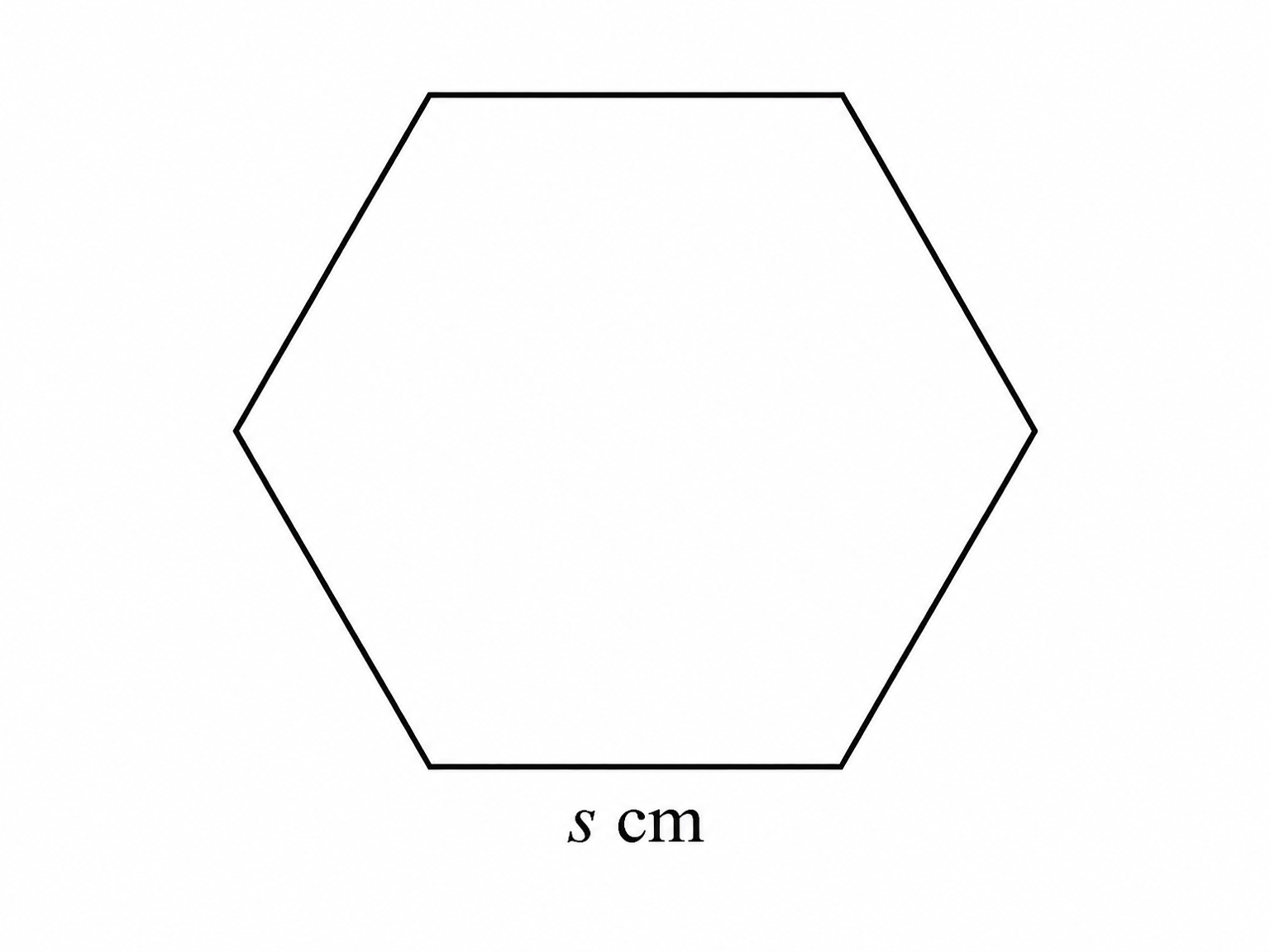
Write a formula for in terms of .
A different regular hexagon has a perimeter of 54 cm.
Use your formula to find the length of one side of this hexagon.
A learner simplifies the expression . Here is the learner's working.
Line 1:
Line 2:
Line 3:
The learner has made one mistake. Write the number of the line where the mistake first happens.
Explain the mistake the learner made.
Write the correct simplified expression.
Children under a certain age travel free on a bus. The number line shows the ages, years, of children who travel free.
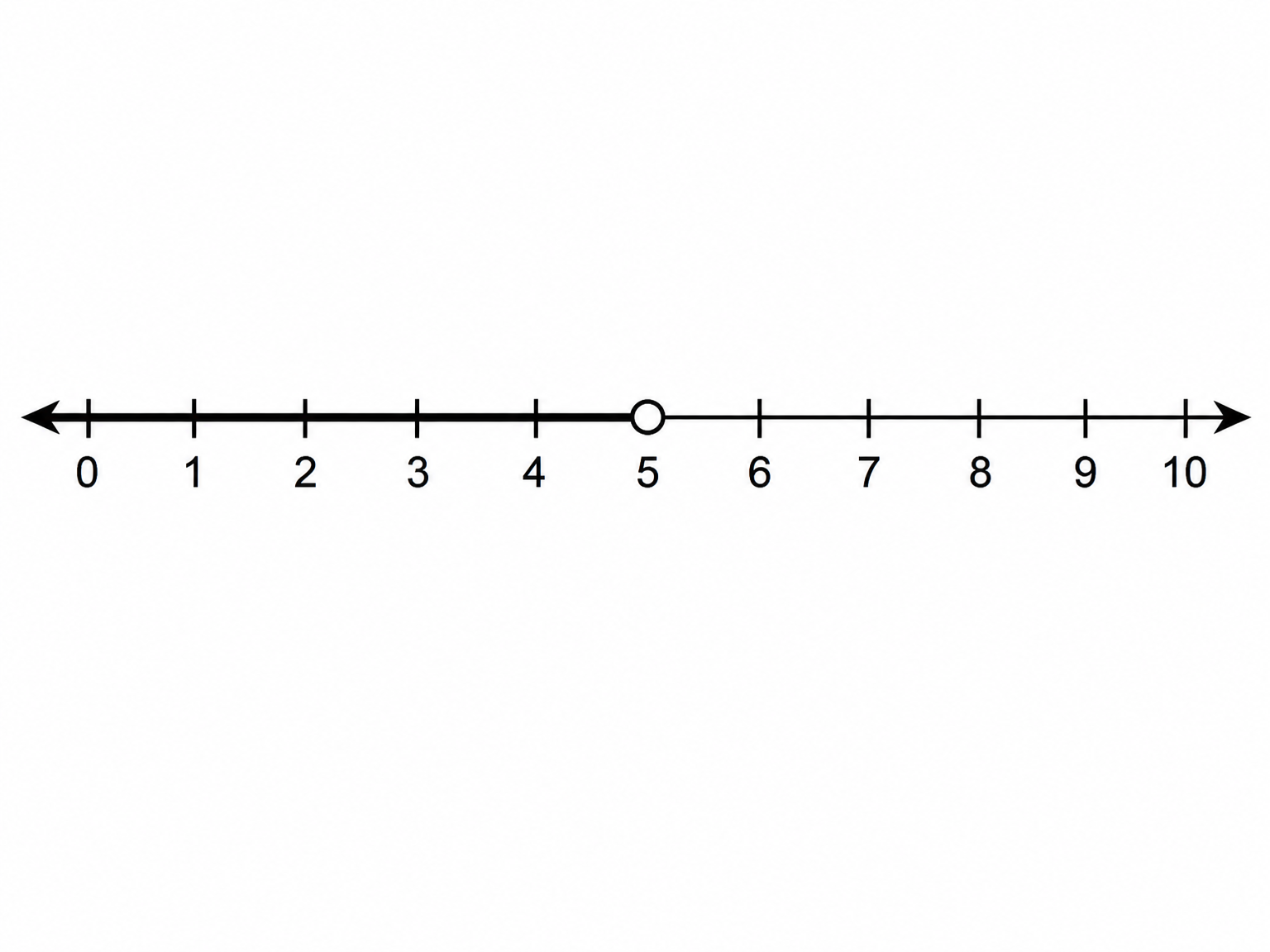
Write an inequality, using , to show the ages of children who travel free.
Write down all the whole number ages of children who travel free. Ages start at 0 years.
A scientist measures the volume of liquid in some samples.
The table shows some calculations. Use the first row to help complete the table.
| Calculation | Answer |
|---|---|
| 900 | |
Complete the table. Use the first row to help complete the table. The first three empty cells need the answers to and is not needed. Write the answers to and in the table.
The scientist has of liquid. Change to litres.
The table shows the height above sea level of four places on a map.
Heights below sea level are negative.
| Place | Height (metres) |
|---|---|
| Cliff top | 12.5 |
| Beach | 0.8 |
| Harbour floor | −3.6 |
| Cave | −7.25 |
Work out how much higher the beach is than the harbour floor.
Work out the difference in height between the cliff top and the cave.
A diver starts at the harbour floor and swims down to the cave.
Complete the calculation to find the change in height.
Four friends share a restaurant bill equally. The bill is $83.60
Ali says,
'I can estimate each share by rounding the bill to $80. Each friend pays about $20.'
Tick (✓) to show if Ali's estimate is sensible or not sensible.
Show how you decide.
Work out the exact amount each friend pays.
The diagram shows a field in the shape of a quadrilateral. Three of the angles are marked. The diagram is not to scale.
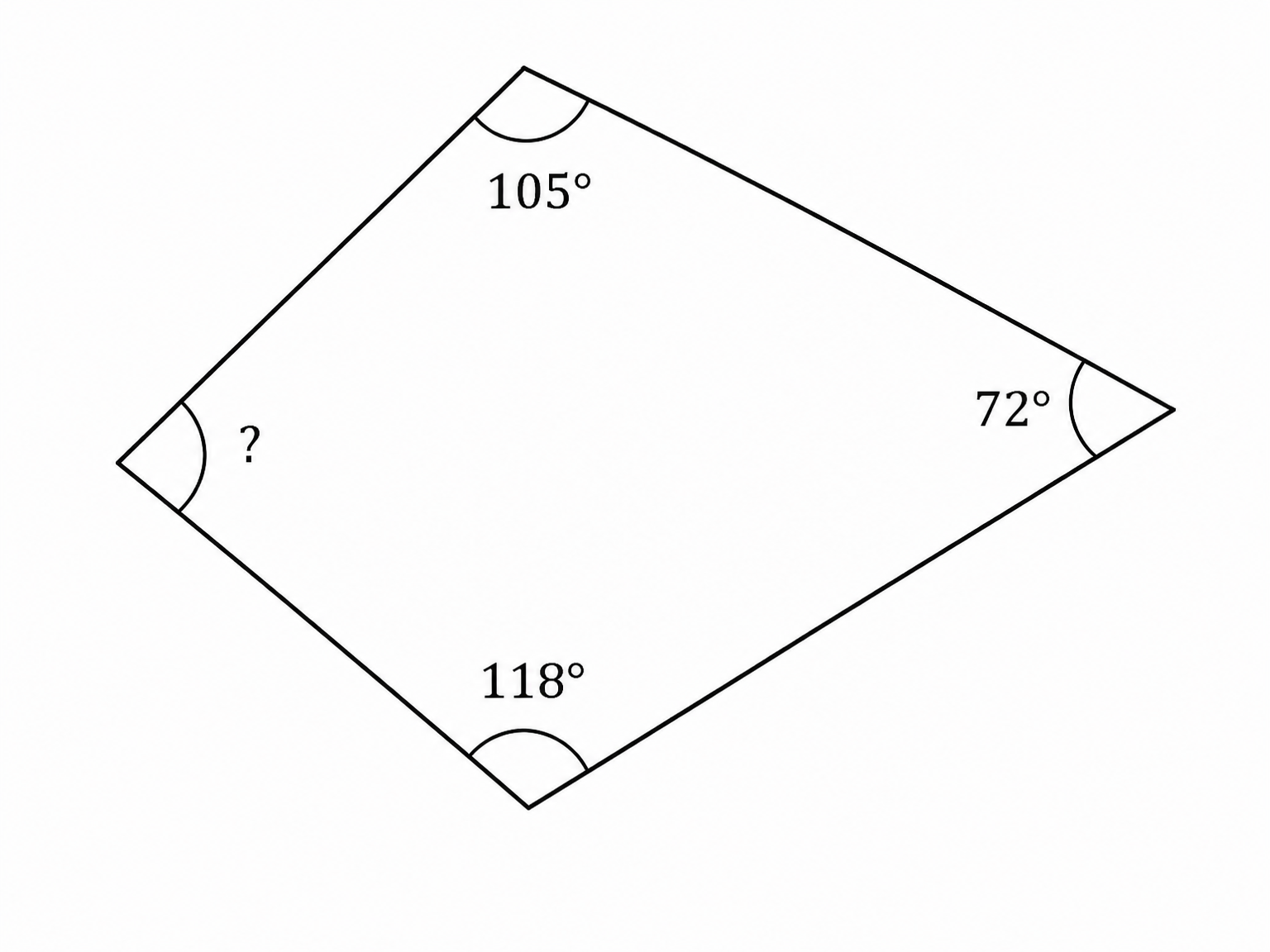
Work out the size of the fourth angle of the field.
Zara says, 'A different quadrilateral has angles of , , and .'
Tick (✓) to show if she is correct or not correct that these four angles can be the angles of a quadrilateral.
Show how you decide.
A factory makes light bulbs. Two workers each test a sample of bulbs from the same production line. The table shows their results.
| Number of bulbs tested | Number of faulty bulbs | |
|---|---|---|
| Worker A | 10 | 0 |
| Worker B | 200 | 10 |
Worker A says, 'None of my bulbs were faulty, so the factory does not make faulty bulbs.'
Worker B says her result is more reliable than Worker A's result.
Explain why Worker B is correct.
Use Worker B's result to predict the number of faulty bulbs in a batch of 4000 bulbs.
Ravi is building a garden path. He lays fencing along one side of the path on two days.
On Monday he lays metres of fencing.
On Tuesday he lays metres of fencing.
Work out the total length of fencing he lays on the two days.
Give your answer as a mixed number in its simplest form.
The path needs metres of fencing in total.
The total length of fencing Ravi has laid is metres.
Find the length of fencing Ravi still needs to lay.
Give your answer as a mixed number in its simplest form.
 Worksheetwww.genzab.ai
More Checkpoint Maths worksheets
See allMake your own
Build a Checkpoint Maths worksheet on your topics
Pick the topics, question count and difficulty, and get a paper-style worksheet with its answer sheet in minutes. New accounts start with 25 free credits.
Sign up free